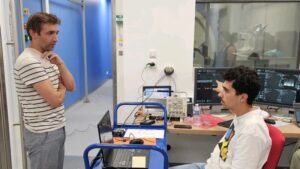

Right heart catheterization (RHC) is a critical diagnostic and interventional procedure widely used to assess cardiac function and pulmonary pressures. Traditionally performed under X-ray fluoroscopy, this procedure exposes both patients and clinicians to ionizing radiation and offers limited visualization of soft tissues.
Recent research from University College London (UCL) introduces a transformative approach: a robotic system capable of performing RHC entirely under real-time Magnetic Resonance Imaging (MRI) guidance. At the core of this breakthrough are Tekceleo’s ultrasonic piezoelectric motors, providing the precision, compactness, and MRI compatibility required for this highly constrained environment.
The Need for MRI-Compatible Robotic Intervention
Performing catheter-based interventions inside an MRI scanner presents unique challenges:
- The limited space inside the MRI bore restricts manual manipulation.
- Conventional metallic or electromagnetic actuation mechanisms risk distorting MRI images or creating safety hazards.
- The complexity of navigating a catheter through the heart’s right chambers demands precise, continuous, and simultaneous translation and rotation.
To address these limitations, UCL researchers developed a compact robot specifically designed for MRI-guided right heart catheterization (MR-RHC), enabling clinicians to remotely control catheter movement with real-time MRI feedback.
Tekceleo’s Ultrasonic Motors: Enabling Safe and Precise Motion
The robotic system integrates two of Tekceleo’s Wavelling series ultrasonic motors:
- WLG-30 motor: Provides catheter translation (advancement and retraction) with a holding torque of 125 mN·m.
- WLG-75 motor: Enables continuous rotation with a holding torque of 1500 mN·m.
Both motors are fully non-magnetic, ensuring MRI-conditionality with no risk of image artifacts or magnetic field interference.
Key technical benefits:
- Infinite simultaneous rotation and translation without mechanical limits.
- Compact integration within an 11 × 8 × 18 cm envelope—small enough to operate directly inside the MRI scanner bore.
- Force and torque outputs exceeding the requirements of manual clinical manipulation (up to 5.35 N force and 7.77 mN·m torque).
Experimental Validation: Key Outcomes
The robotic system was rigorously tested using seven patient-specific anatomical phantoms replicating real cardiovascular anatomies. The validation was conducted entirely under MRI guidance.
Results at a glance:
- 100% procedural success rate: The robot successfully navigated the catheter from the inferior vena cava to the pulmonary artery in all cases.
- Improved trajectory consistency: Robotic interventions achieved a 33.9% reduction in trajectory deviation compared to manual procedures.
- MRI safety confirmed: Signal-to-noise ratio (SNR) variation remained below 3.5% in all operating conditions, with no observed image distortion.
- Reduced procedure time: Robotic teleoperation was consistently faster or more consistent than manual interventions, improving overall reliability.
Why Ultrasonic Motors Matter in MRI Robotics
This research highlights the critical role of piezoelectric ultrasonic motors in enabling robotic procedures within MRI environments:
- They operate without magnetic interference or RF emission.
- They offer high-precision motion control in very compact form factors.
- They avoid the latency and bulkiness of hydraulic or pneumatic systems, which are less suited for miniaturized, in-bore applications.
Tekceleo’s ultrasonic motors provided the reliability, power, and safety margin needed to meet both the mechanical and imaging constraints of this application—proving that robust actuation is possible even in the most restrictive environments.
Perspectives: Toward Autonomous MRI-Guided Interventions
This successful preclinical validation opens the door to several promising directions:
- Future animal model trials and eventual human clinical studies.
- Integration of robot sterilization protocols for operating room use.
- Development of autonomous navigation algorithms, potentially powered by AI and reinforcement learning.
The ability to perform radiation-free, highly controlled cardiac interventions directly under MRI guidance could transform interventional cardiology, especially in pediatric and complex congenital cases where precision and soft tissue visualization are paramount.
Tekceleo: Enabling the Next Generation of Medical Robotics
At Tekceleo, we are proud to support cutting-edge medical research by providing MRI-safe actuation solutions through our Wavelling range of ultrasonic motors. This project demonstrates that precision, compactness, and MR-conditionality can coexist—unlocking new possibilities for surgical and diagnostic robotics in sensitive environments.
👉 Learn more about our MRI-compatible ultrasonic motors: https://www.tekceleo.com/piezoelectric-motors/