Micronice® Use Case Automated Bio-Decontamination in BSCs and Isolators
Discover how Tekceleo’s Micronice® ultrasonic vibrating mesh nozzle enables EN 17272-compliant dry fogging with hydrogen peroxide (H₂O₂) and peracetic acid (PAA) – compact, scalable, and validated for BSCs and isolators.
Why an automated decontamination process in a BSC?
Biological safety cabinets (BSCs) and pharmaceutical isolators are essential to laboratory and bioproduction safety. A key challenge lies in ensuring validated, repeatable bio-decontamination of internal surfaces without costly downtime or reliance on external devices.
Traditional approaches—portable fogging units, manual disinfection, or VHP generators—are effective but often complex, expensive, and disruptive.
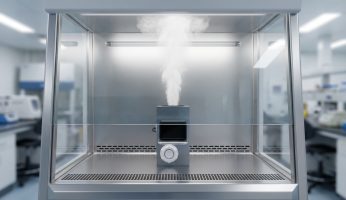
Tekceleo’s Micronice® vibrating mesh nozzle offers a breakthrough alternative: a compact, embedded, and fully validated OEM solution that generates a fine dry fog of H₂O₂ or PAA, meeting the requirements of EN 17272 and supporting the most stringent customer protocols.
EN 17272: The Reference Standard
The European standard EN 17272 specifies airborne room disinfection systems must achieve defined log reductions in resistant microorganisms. For “medical area” applications, requirements include:
- ≥ 5-log reduction for vegetative bacteria
- ≥ 4-log reduction for yeasts and fungi
- ≥ 4-log reduction for viruses
- ≥ 4-log reduction for mycobacteria
- ≥ 4-log reduction for bacterial spores
Micronice® has been validated to meet these thresholds inside BSCs, confirming its suitability for laboratory and pharmaceutical environments.
Additional Validation: Beyond the Norm
In addition to EN 17272 compliance, independent customer trials have demonstrated that Micronice® technology can achieve a ≥6-log₁₀ reduction of Geobacillus stearothermophilus spores under defined test conditions.
Since G. stearothermophilus is widely recognized as one of the most resistant organisms to oxidizing agents, achieving log-6 inactivation provides a pharmaceutical-grade assurance level. This demonstrates that Micronice® can exceed regulatory minimums and deliver robust sterilization performance.
How Erlab-Noroit Implemented Micronice in Its BSCs
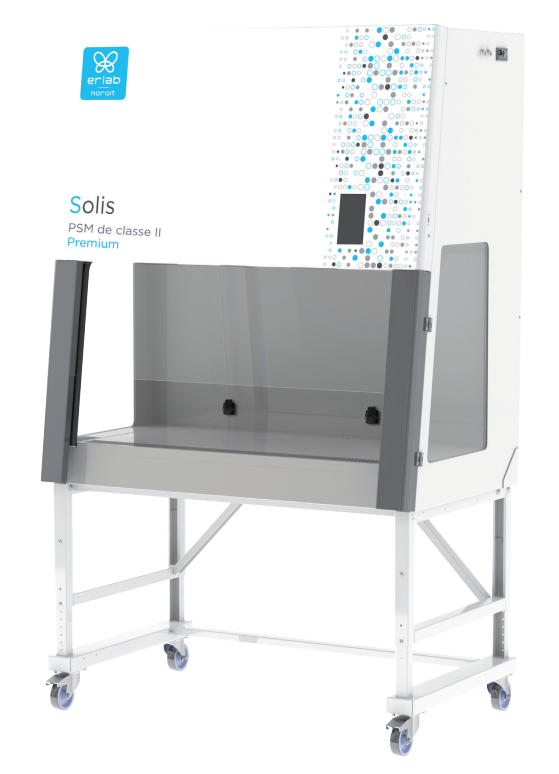
Erlab-Noroit’s engineering team undertook a six-month integration program to adapt Tekceleo’s Micronice® ultrasonic nozzle to its Solis range of biological safety cabinets. The process began with feasibility studies and spatial design, since available space inside a BSC is limited and noise must remain minimal.
Once the H360 M05 HP nozzle and ECU were selected, the system was mechanically and electronically integrated, with the nozzle positioned to ensure uniform fog distribution and a seamless connection to the cabinet’s HMI and safety interlocks.
A full validation campaign under EN 17272 followed, confirming compliance and ensuring regulatory robustness. The result was a market-ready cabinet with automated decontamination capability, launched within six months and since adopted in labs worldwide.
This structured process illustrates how Micronice® can be integrated quickly and efficiently into OEM product lines, creating a durable competitive advantage.
Technology Overview: The Micronice Vibrating Mesh Nozzle
For their automated decontamination solution, Erlab-Noroit used the following parts from Tekceleo :
- Nozzle Model used: H360 M05 HP nozzle
- Droplet size: 5 µm – ultra-fine dry fog, no condensation
- Compatibility: H₂O₂ (<15%) and PAA
- Form factor: 20 mm diameter, highly compact
- System components: Nozzle + ECU (Electronic Control Unit)
Advantages for OEMs and users:
- Easy integration – minimal components, direct HMI interface
- Scalable – one nozzle in BSCs, multiple in isolators
- Maintenance-free – resistant to oxidizing agents
- Quiet – suitable for daily laboratory operation
Case Study: Erlab-Noroit Solis BSC Integration
As part of a strategic initiative to differentiate its high-end Solis Class II biological safety cabinets, Erlab-Noroit undertook a complete integration of Tekceleo’s Micronice® H360 M05 HP vibrating mesh nozzle. The engineering process, which spanned approximately six months from initial specification to commercial launch, involved designing a compact solution compatible with the tight space constraints of BSCs, while ensuring silent operation and seamless connection to the cabinet’s existing HMI and safety systems.
The final configuration integrated one nozzle per cabinet, with the option to add a second nozzle for customers requiring faster cycles. Performance was validated according to EN 17272, demonstrating reliable and repeatable efficacy. Supplementary biological indicator testing further proved a ≥6-log₁₀ reduction of Geobacillus stearothermophilus spores, providing pharmaceutical-grade assurance.
Key outcomes of the integration:
- Timeline: ~6 months from specification to market launch
- Validation: EN 17272 compliant with H₂O₂ cycles (7 min spray + 2 h contact)
- Scalability: Dual-nozzle option reduced spray time to ~3 minutes
- Robustness: Independent BI tests confirmed ≥6-log₁₀ spore reduction
- Reliability: 3+ years of continuous use, no reported after-sales failures
- Business impact: Competitive differentiation through built-in automated decontamination
Since its launch, the Solis BSC line has delivered long-term stability and reliability, positioning Erlab-Noroit as a pioneer in offering embedded, validated dry-fogging systems as a standard or optional feature.
Performance Summary
- Validated disinfectants: H₂O₂ (7.8%) and PAA
- Cycle time: 7 min spray + 2 h contact (1 nozzle) / ~3 min spray + shorter dwell time (2 nozzles)
- Efficacy: EN 17272 compliant; supplementary validation showed log-6 spore reduction (G. stearothermophilus)
- Reliability: 3+ years, no failures, zero maintenance
Benefits for OEM and End Users
✅ EN 17272 compliance out-of-the-box
✅ Independent testing demonstrating log-6 G. stearothermophilus reduction
✅ Seamless OEM integration, minimal components
✅ Cost savings vs. VHP generators and external services
✅ Scalability from BSCs to isolators
Use Case Review and Future: Scalability and Performance
Thanks to its compact size and modular design, the Micronice® system extends easily to larger containment systems:
- 2–5 nozzle arrays for isolators and airlocks
- Uniform fog distribution across complex geometries
- Same control logic and safety interlocks, simplifying replication and validation
- Minimal footprint: only 20 mm per nozzle
This scalability allows OEMs to deploy a single validated technology across multiple product lines.
Join the Future of Pharmaceutical Sterilization
Contact Us for a Consultation
Are you ready to experience the transformative technology of Micronice for small volume sterilization? Contact our team of experts today for a comprehensive consultation and discover how amplified vibrating mesh technology can elevate your pharmaceutical manufacturing processes. With Tekceleo’s Micronice aerosol generator, precision, reliability, and efficiency are within your reach.
Our Articles
Contamination control has become a critical operational challenge across pharmaceutical manufacturing, laboratories, healthcare environments, biotechnology facilities and high-sensitivity industrial applications. As regulatory expectations increase and operational flexibility becomes essential, traditional disinfection methods often struggle to provide the required combination of…

A newly published study from Seoul National University highlights an emerging phenomenon that engineers and technology developers should watch closely: micron-scale water droplets can function as a powerful, reagent-free viral disinfection platform. What makes this work particularly relevant is that…

Why Humidification Matters More Than Ever For decades, humidification in supermarkets and grocery stores has relied on traditional misting systems. These methods were designed to keep fresh produce hydrated, but they often brought unwanted side effects: over-wetting, high energy costs,…
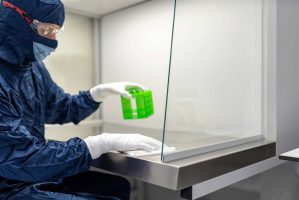
At Tekceleo, we believe that bio-decontamination should be both robust and simple—a process that ensures compliance while reducing complexity for users and manufacturers alike. We are pleased to share a new use case white paper showcasing how a leading European…
We are proud to announce the launch of PROMI (Programmable Robotics for MRI Integration), a major R&D project led by Tekceleo and co-funded by the European Union.PROMI represents a bold move into the future of surgical robotics, with one clear…
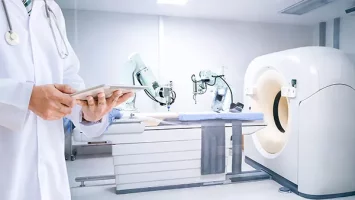
Right heart catheterization (RHC) is a critical diagnostic and interventional procedure widely used to assess cardiac function and pulmonary pressures. Traditionally performed under X-ray fluoroscopy, this procedure exposes both patients and clinicians to ionizing radiation and offers limited visualization of…

Rethinking Mineral Processing for a Cleaner Future As global demand for critical metals like copper continues to surge—driven by electrification, renewable energy infrastructure, and battery technologies—mining operations are under growing pressure to optimize resource use while reducing their environmental footprint.…
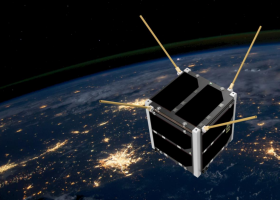
The space industry is constantly evolving, driven by innovative technologies that push the boundaries of what's possible. One such innovation is the use of ultrasonic motors, in space applications. In this application Tekceleo's WLG-30 piezoelectric motor has proven its mettle…

At Tekceleo, we push the boundaries of precision with our WLG-30 motor. In this demonstration video, we highlight the exceptional capabilities of our Wavelling technology, based on progressive wave ultrasonic motors. Why the WLG-30 Motor Stands Out: Micrometer Precision: The WLG-30…
Understanding the transmission of respiratory pathogens is essential for developing effective health strategies. Recent advancements in aerosol generator technology are providing researchers with the tools needed to study these phenomena with unprecedented precision. At Tekceleo, our aerosol generator solutions are…