Project update, July 2026
On July 7 and 8, the Tekceleo team spent two full days inside an MRI suite at the CHRU de Nancy. We ran the first test campaign of the PROMI project on a 3T clinical scanner operated by the IADI laboratory (INSERM / Université de Lorraine), with the support of our partner Healtis. This post is a field update on what we did and how we did it. The detailed results will come in a dedicated post once the full analysis is complete.
Why we ran this campaign
Tekceleo has supplied MRI compatible ultrasonic motors for years. Because our Wavelling® motors are non-magnetic and contain no ferromagnetic materials, the motor itself has never been the real barrier to robotics inside an MRI. The barrier is the full chain around it: the sensors that close the control loop, the cabling, the signal transmission, and the control electronics. Until now, every integrator who wanted to build a motorized system for the MRI environment had to solve that chain on their own, and it took considerable time and effort.
PROMI exists to remove that burden. The goal is to deliver a complete, integrated actuation module that a MedTech company or a research team can drop into their own device, without having to re solve the actuation problem from scratch.
Before we can offer that kind of plug and play module, we need to understand exactly how the full system behaves in a real MRI, in the conditions where the physics is most demanding. That is what this campaign was about.
What we set up
We built a dedicated test bench and placed it directly inside the bore of the scanner. The bench carried a motor module with fiber optic signal transmission, and it was designed to measure several things at the same time.
We measured precision and indexing on the encoder side of the module. We measured the speed and torque of the motor itself. To make sure our numbers were solid, we did not rely on a single measurement. We added an external optical encoder and a mechanical revolution counter, so that every value could be cross checked against two independent references. When you are working inside a 3T magnetic field, this kind of redundancy is the difference between a measurement you can trust and one you cannot.
What we tested
A motor that works at the center of the scanner is not enough. A real robotic module has to behave predictably everywhere a surgeon or a device might need it, and under the sequences that a clinical exam actually uses.
So we tested the module at several positions inside the scanner, from the bore entrance to the isocenter, including the point where the spatial gradients are at their maximum. We tested the motor along its three axes of orientation relative to the main magnetic field. And we tested it under different conditions of the scanner, from static field to active imaging sequences, including the sequences that put the most stress on the system through their radiofrequency emission.
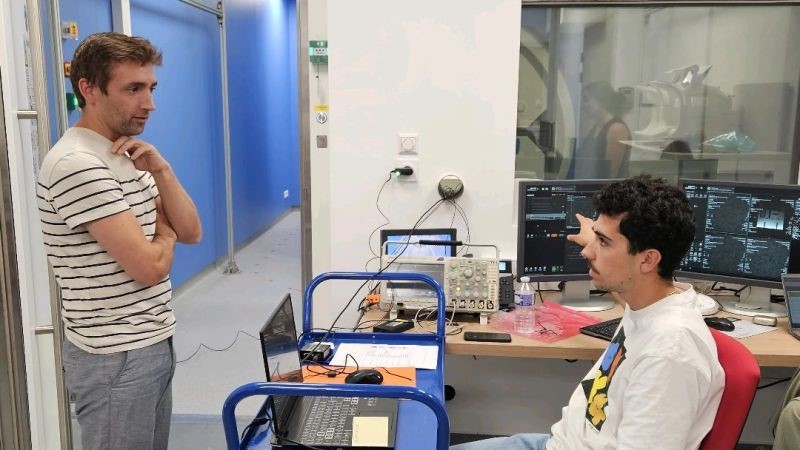
Across these two days, the team worked directly in the MRI room, mounting configurations, running sequences, recording data, and discussing results between each run. Testing in a clinical MRI is not a lab exercise. Access time is limited, the environment is constrained, and every configuration change has to be done carefully inside the magnet. Two days of this is intense, and it produced a large and valuable dataset.
What comes next
We are now analyzing the full set of measurements. The numbers are very encouraging, and they give us the core hypotheses we needed to define a module that can operate across the different zones and sequences of a 3T MRI.
The next steps are clear. We will fine tune the module toward a true plug and play solution built on our Wavelling® ultrasonic motor technology, and we will then integrate it on a prototype robot developed in partnership with IADI (INSERM / Université de Lorraine). We will publish a dedicated post with the detailed results and what they mean for MRI guided robotics once the analysis is finalized.
If you are working on motorized or robotic systems for the MRI environment, we would be glad to talk. This kind of exchange is exactly what shapes what PROMI should become.
PROMI (Programmable Robotics for MRI Integration) is an R&D program led by Tekceleo, co funded by the European Union through the FEDER and Région Sud PACA, with academic partners University College London (UCL) and IADI (INSERM / Université de Lorraine). Learn more on the PROMI project page.